- Home >
- Insights >
- Lals story
- Author:
- Tillie Dee
- Date:
Lal's story
What happens when a 76-year-old farmer gets to shape global food policy? Lessons from a Nepali smallholder bringing a lifetime of agricultural knowledge to global food systems decision-making.
The way we grow and eat food is now one of the biggest drivers of the climate crisis, and the people who had the least to do with that are the ones paying for it.
Nearly half the world doesn't have reliable access to healthy food. The communities facing the sharpest end of that, erratic seasons, degraded land, rising costs, are mostly people who farm small plots, feed their neighbors, and have been doing so for generations.
Nepal is a vivid example. The country made food a legal right in 2018, yet one in eight households still can't count on having enough. It's also among the most climate-exposed countries on earth, and the pressure keeps building. Rains that once arrived on schedule no longer do. Fertilizer prices have jumped 60% this year, pushed up by conflict thousands of miles away, landing on farmers who were already stretched.
We plant more and get less back
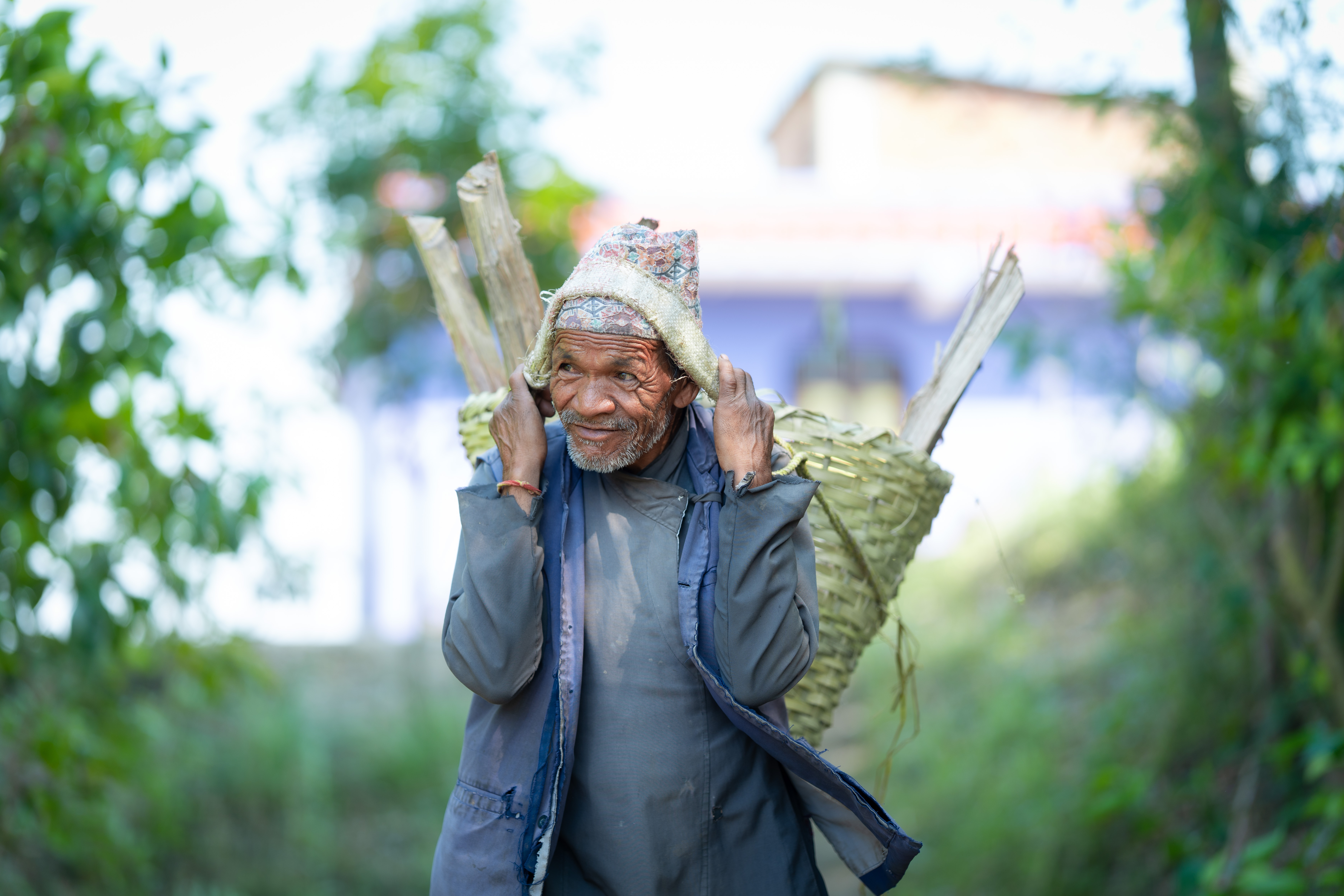
In Surikhe, that farmer is Lal. He's 76, and he's up at three every morning. He has buffalo to milk, a walk to the dairy, then back to his wheat and maize before the heat of the day sets in. He'll do it all again in the afternoon. He has farmed this way for most of his life, and watched everything around him slowly change.
"In the past, a small amount of seeds would give us a large harvest. Now we plant more and get less back,” he says. “The drought has taken something from the soil. There is no softness in it anymore."
Lal's story is one of deep experience. He grew up in the remote Kali Kaur district, where he once walked for a month just to collect salt from Nepal. He moved in search of a better life and built one through farming. But systems like his, built on a lifetime of close observation and hard-won knowledge of the land, are almost never present in the rooms where global climate and food policy is made, even when they contain precisely the kind of knowledge those rooms are trying to act on.
Ordinary people, global decisions
This year, that changed for Lal. He participated in the Global Citizens' Assembly for Food Systems and Climate, an attempt to disrupt the narrow, technocratic patterns that dominate global food governance.
Citizens' assemblies are deliberative processes in which ordinary people, selected by lottery, are brought together to engage seriously with complex policy questions. They are designed not to replace expertise, but to ensure that lived experience sits alongside it.
As of 2023, there were over 700 documented deliberative assemblies globally. In Ireland, they helped break political deadlock on same-sex marriage and abortion. In France, a national climate assembly produced 149 proposals, several of which became law.
The Global Citizens' Assembly extended this model globally, bringing together 105 people from different countries, ages, education levels, and lived experiences to confront how we make food systems fairer and more resilient in a changing climate.
A simple farmer transformed
For Lal, the experience was startling in ways he hadn't anticipated. He had spent his life farming in a remote valley, aware of his own community but largely unaware of how his world connected to wider systems of governance, policy, and power.
“I was just living my life as a simple farmer. I never thought about the rules of governments, the rules of organizations, or that I was connected to them. That was very new for me."
Seeing faces from across the world appear on a screen was itself a kind of revelation. But what stayed with him was the substance: learning that the problems he had long attributed to local conditions, the shrinking harvests, the degrading soil, the unreliable water, were part of something larger, shaped by decisions made far away, by people who had never walked his fields.
This is what citizens' assemblies are designed to do, create the conditions for that kind of exchange. Not debate, where the goal is to win, but deliberation, where the goal is to understand.
Changing perspectives and harmful practices
When the assembly turned to the question of who should benefit from support, small farmers or large agri-businesses, participants brought their different experiences to bear. Lal spoke from his. He explained what it looks like to do the physical work of growing, harvesting, feeding, and to receive only a fraction of the value that work creates while industries capture most of the profit.
Other participants saw it differently, arguing for the role of industry in feeding a growing world. They talked it through. By the end, the group had found its way to a shared position through the weight of those stories, not through point-scoring.
The exchange changed Lal's perspective too. During discussions about chemical fertilizers, he found himself listening as others described the long-term damage to soil and to the communities living alongside industrial agriculture. He had used chemicals on his own farm for years, drawn by the speed of the results. But hearing others' experiences alongside the evidence shifted something.
"I came to understand how it harms the environment. I will grow healthy, organic food now. I will use my buffalo and natural ways instead."
A global deliberation had changed the practice of a 76-year-old farmer, not through instruction, but through the simple act of being genuinely heard and genuinely listening.
Hopes for what comes next
Critics of citizens' assemblies often argue that ordinary people lack the expertise to engage meaningfully with complex policy. But these processes are not designed to replace experts. They are designed to rebalance who exercises judgment in systems where decision-making has long been concentrated in a narrow set of institutions.
The outcomes tend to hold up. When tested against wider publics, through polling in France, referendums in Ireland, citizens' assembly recommendations have consistently received strong public support.
By the end of the process, the 105 assembly members had agreed on 22 Calls to Action. Those recommendations are now being presented to policymakers at international climate meetings, at the request of the COP30 Presidency.
Lal has his own hopes for what comes next. He wants farmers to have access to soil testing, so they can understand what their land needs rather than guessing. He also wants to share what he has learned with others in his community. As he puts it:
"I'm growing old. I do not have much longer. But until I have breath in my body, I would like to share my learning from this assembly."